DP-800 Study Guide
A curated learning path for the DP-800 exam: the best documentation, videos, blog posts and tutorials for every exam objective.A curated learning path for the DP-800 exam: the best documentation, videos, blog posts and tutorials for every exam objective, in the order worth studying them.
Microsoft Certified: SQL AI Developer Associate
Exam at a Glance
DP-800 measures whether you can do the day-to-day work of a developer building AI-enabled database solutions on Microsoft SQL platforms: designing tables and T-SQL on SQL Server, Azure SQL and SQL database in Fabric, securing, tuning and shipping them through CI/CD, and adding embeddings, vector search and RAG inside the database.
| DP-800 | Developing AI-Enabled Database Solutions |
|---|---|
| Level | Intermediate (associate role-based exam) |
| Exam length | 120 minutes |
| Questions | Typically 40 to 60; the number and format mix can vary |
| Passing score | 700 out of 1000 |
| Question formats | Multiple choice, multiple select, drag and drop, build list, hot area, case studies, possibly labs |
| Microsoft Learn access | Available within the exam; browsing is restricted and the timer continues |
| Skills measured version | October 19, 2026 |
| Renewal | Certification expires annually; renew with a free online assessment on Microsoft Learn |
What the Exam Covers
Three domains: the two classic database domains at 35-40% each and the AI domain, the smallest, at 25-30%. Coming for vector search and RAG while skimming the T-SQL, security and CI/CD bullets would leave most of the syllabus uncovered. Questions name a platform and a requirement and ask which T-SQL feature, security control, deployment mechanism or AI function meets it.
Design and develop database solutions — 35-40%
Building the database: tables, indexes and columnstore; specialized tables (in-memory, temporal, external, ledger, graph); JSON columns, constraints, sequences and partitioning; views, functions, stored procedures and triggers. Advanced T-SQL covers CTEs, window functions, JSON, regular-expression and fuzzy-matching functions, graph MATCH queries and error handling. The domain also covers AI-assisted development with GitHub Copilot and Copilot in Fabric, including instruction files and MCP server endpoints.
Secure, optimize, and deploy database solutions — 35-40%
Security questions ask for the right control: Always Encrypted, column-level encryption, Dynamic Data Masking, Row-Level Security, object-level permissions, passwordless access or auditing, plus securing GraphQL, REST and MCP endpoints. Performance covers isolation levels, execution plans, DMVs, Query Store, blocking and deadlocks. CI/CD runs through SQL Database Projects, and Azure integration covers Data API builder, Azure Monitor, and change handling with change event streaming, CDC, Change Tracking, Azure Functions or Logic Apps.
Implement AI capabilities in database solutions — 25-30%
Embeddings from external models (column choice, chunking, maintenance), then intelligent search: full-text, vector or hybrid search, the vector data type and indexes, VECTOR_DISTANCE and VECTOR_SEARCH, approximate or exact nearest neighbors, and reciprocal rank fusion. RAG questions cover building prompts with sp_invoke_external_rest_endpoint, converting rows to JSON, sending results to a language model and extracting its responses.
The full bullet list is in Microsoft's study guide, linked in Step 1 below.
How This Maps to CertiAce Practice Modules
The three CertiAce practice modules map one-to-one to the exam domains:
| CertiAce practice module | What you will drill there |
|---|---|
| Design and develop database solutions | Table and index design, specialized tables, JSON, programmability objects, advanced T-SQL, Copilot and MCP tooling |
| Secure, optimize, and deploy database solutions | Encryption, masking, RLS, auditing, query tuning, SQL Database Projects, Data API builder, monitoring and change handling |
| Implement AI capabilities in database solutions | External models, embeddings, vector and hybrid search, vector indexes, RAG with sp_invoke_external_rest_endpoint |
Where DP-800 Fits
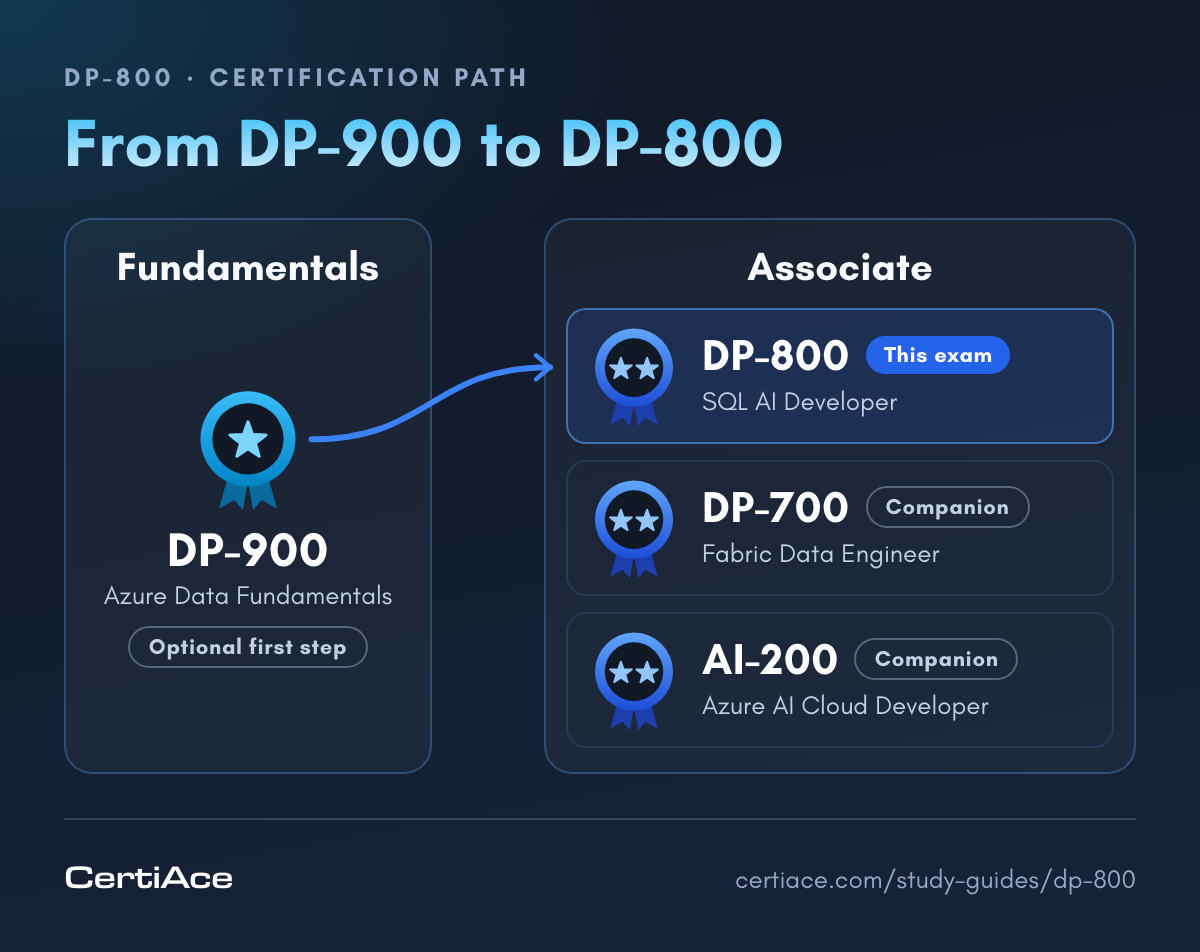
| Certification | What it validates | When to take it |
|---|---|---|
| DP-900: Azure Data Fundamentals | Core data concepts and Azure data services | Optional first step if you are new to data work or cloud platforms |
| DP-800: SQL AI Developer Associate (this exam) | Designing, securing, deploying and AI-enabling database solutions on Microsoft SQL platforms | You are here |
| DP-700: Fabric Data Engineer Associate | Data engineering on Microsoft Fabric, the analytics side of the platform | A natural companion if your SQL database in Fabric feeds analytics |
| AI-200: Azure AI Cloud Developer Associate | Back-end AI solutions on Azure, including vector databases and messaging | A natural companion if you build the application tier around your database |
DP-800 has no official prerequisites, and passing it is not a prerequisite for any other Microsoft certification. If you are new to SQL, data concepts or cloud platforms, starting with DP-900 is strongly recommended: it builds the vocabulary DP-800 assumes without being required. If you already write T-SQL on SQL Server or Azure SQL and understand embeddings and vectors conceptually, go straight to DP-800.
Before You Start
The exam assumes practical database development experience, not just reading. Anything unfamiliar in this table is where to start:
| Area | You should be comfortable with |
|---|---|
| T-SQL and relational design | Joins, aggregations and subqueries; tables, views, stored procedures, functions and indexes; transactions; structured and semi-structured (JSON) data |
| Microsoft SQL platforms | How SQL Server, Azure SQL Database, Azure SQL Managed Instance and SQL database in Microsoft Fabric differ and when to choose each |
| AI concepts | Embeddings, vectors, similarity search and retrieval-augmented generation at a conceptual level |
| Application development and DevOps | Connecting applications to SQL, REST and GraphQL basics, Git branching and pull requests, GitHub Actions and GitHub Copilot at an awareness level |
| Security and operations | Microsoft Entra ID authentication and managed identities, least privilege, encryption at rest and in transit, basic monitoring |
Commonly Confused Pairs
These pairs tend to show up together as the two plausible answers to one question:
| Looks similar | The difference that decides the answer |
|---|---|
| Temporal table or ledger table | A temporal table keeps the full history of row changes, so you can query the data as it was at any point in time, analyze trends or recover from accidental changes. A ledger table also keeps history but adds cryptographic hashes and database digests, so you can prove to an auditor that nobody, administrators included, has tampered with the data. |
| JSON_VALUE or JSON_QUERY | JSON_VALUE extracts a single scalar value, such as a string or a number. JSON_QUERY extracts an object or an array; in the default lax mode it returns NULL when the path points to a scalar. |
| Always Encrypted or Dynamic Data Masking | Dynamic Data Masking only changes what query results show: the stored data is unchanged, administrators and users granted UNMASK see real values, and users running ad hoc queries can infer masked values. Always Encrypted encrypts columns in the client driver with keys the database engine never sees, so even administrators can't read the plaintext. |
| Read committed snapshot or snapshot isolation | With READ_COMMITTED_SNAPSHOT on, each statement sees the data as it was when that statement started, so two reads in one transaction can return different results. SNAPSHOT isolation shows every statement the data as it was when the transaction started, and the database needs ALLOW_SNAPSHOT_ISOLATION turned on first. |
| Change Tracking or change data capture | Change Tracking records synchronously that a row changed but not the values, so the application reads the current row from the table, which suits keeping another copy in sync. Change data capture reads the transaction log asynchronously and stores the changed data in change tables, giving a history of the values over time. |
| Full-text search or vector search | Full-text search matches words and phrases by language rules, including inflected forms, thesaurus synonyms and words near each other, so it finds the terms you ask for. Vector search compares embeddings with a distance metric such as cosine, so it finds content that is close in meaning even when the wording differs. |
Step-by-Step Study Plan
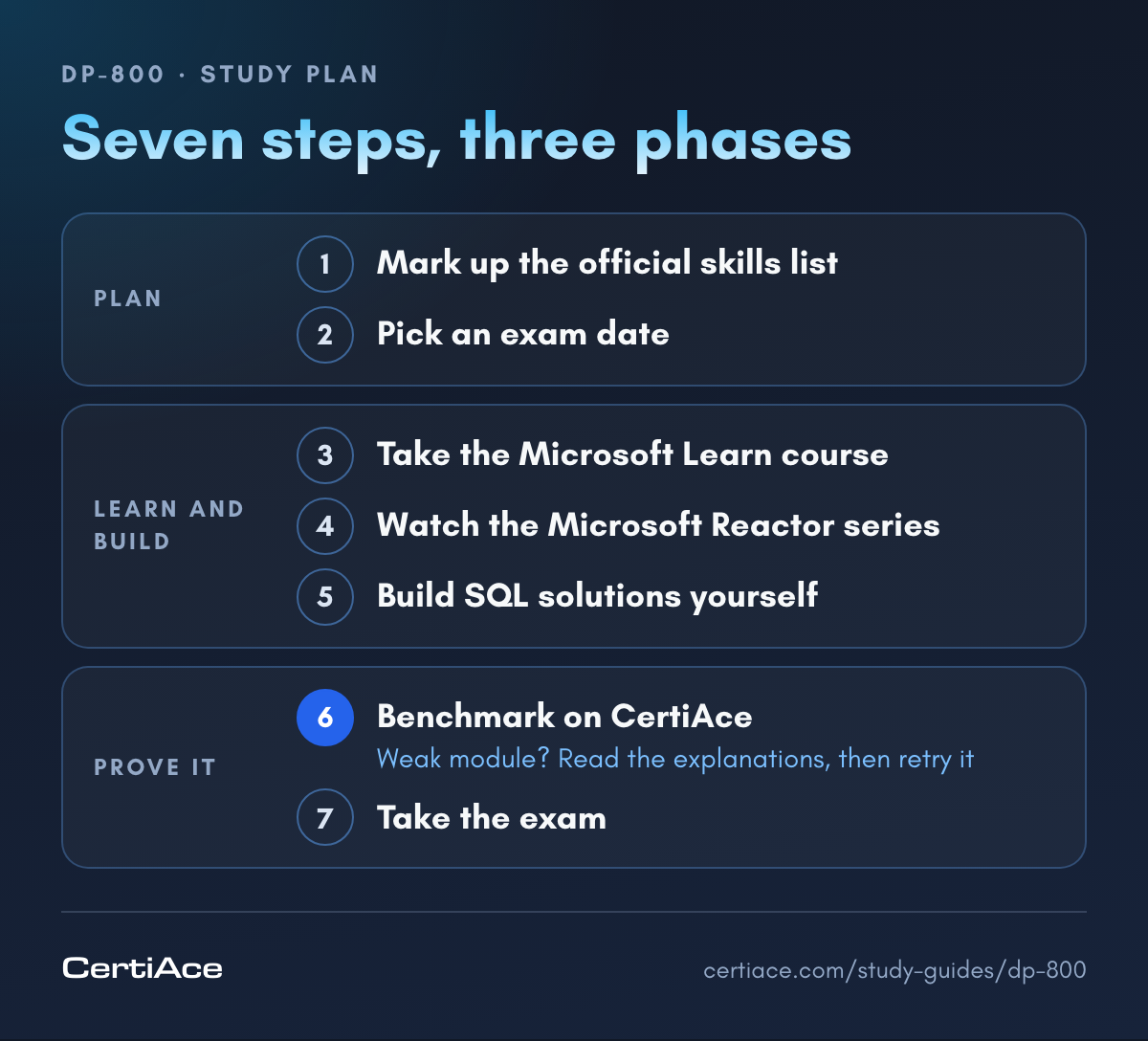
Treat these estimates as planning guidance and adjust them to your starting knowledge and weekly study hours:
| Your starting point | Suggested prep time |
|---|---|
| Already working with SQL Server or Azure SQL and its AI features | 3 to 5 weeks |
| You know SQL, but AI-enabled database solutions are new to you | 5 to 8 weeks |
Step 1: Read the Official Study Guide
Skim the full skills-measured list once, and mark every bullet you could not explain to a colleague. DP-800 is a young exam: revisit the page before you sit.
Step 2: Schedule Your Exam
Choose a realistic target date after reviewing the skills list and your available study time, then work backwards from it with the prep-time table above. The exam is offered in English only. If the exam is not available in your native language, check the English as a Second Language accommodation and arrange any approved extra time before booking.
Certification and Exam Details Page
Step 3: Work Through the Official Learning Path
Complete the DP-800 course modules on Microsoft Learn: eleven modules grouped by the three exam domains, each ending in a hands-on exercise. Write down every concept you cannot explain in simple terms, and flag the ones to practice in Step 5, especially specialized tables, the newer T-SQL functions, SQL Database Projects and vector search.
Official Learning Path Course Page
Step 4: Watch a Full Video Course
No full-length DP-800 video course exists yet. The best substitute is Microsoft Reactor's official "Get Certified: SQL AI Developer (DP-800)" series: six hour-long recorded sessions covering the exam outline, design and development, security and deployment, embeddings, search and RAG, and exam-day preparation. Watch them after the learning path and replay your weakest domain later.
Get Certified: SQL AI Developer (DP-800)
Step 5: Get Hands-On Practice
DP-800 rewards real experience building, securing and shipping SQL solutions. SQL Server 2025 Developer edition, the Azure SQL Database free offer and the Fabric trial support many of the core exercises at no cost. Some AI objectives need a model endpoint for the embedding and RAG calls or Copilot licensing, so cover those from the documentation or a demo if you cannot deploy them. The official lab repository is still only a template, so build from the module exercises and make sure you personally touch:
- A temporal or ledger table with JSON columns and constraints, queried with window, JSON and regular-expression functions
- Row-Level Security, Dynamic Data Masking, Always Encrypted and passwordless Microsoft Entra authentication
- An execution plan and Query Store used to resolve a blocking or deadlock problem
- A SQL database project deployed through GitHub Actions, then exposed through Data API builder
- Embeddings stored in the vector data type, VECTOR_DISTANCE and VECTOR_SEARCH queries, and a model call through sp_invoke_external_rest_endpoint
Deploy Azure SQL Database for free
Step 6: Benchmark Your Knowledge
Use CertiAce to benchmark your readiness module by module. The practice modules map to the exam domains as shown above, so use the module mapping and the topics behind your missed questions to identify the skills-measured areas to revisit. Microsoft also offers a free official practice assessment for DP-800 on AI Skills Navigator (sign in to launch it). It is a useful extra check, but it tends to be somewhat easier than the real exam. CertiAce questions are written to sit closer to the real exam's difficulty. If a module stays weak, read the explanations on the questions you missed, then retry that module.
Official Practice Assessment on AI Skills Navigator
Step 7: Take the Exam
The day before, review only your weak topics. In the exam, watch for constraints such as least privilege, cost, performance, or operational simplicity, and notice which platform the scenario names. That often eliminates half the options.
- Microsoft Learn is available during the exam in a split screen. Use it to check details you genuinely need: the timer keeps running, and the exam is deliberately too long to look up every answer. Browsing is limited to Microsoft Learn itself (no Q&A, practice assessments, or profile), and personal notes and other websites are unavailable.
- You can take unscheduled breaks, but the clock keeps running and you cannot return to questions you already saw.
- Case studies lock when you leave them: finish each one before moving on, because you cannot revisit its questions afterwards.
- Labs may appear: DP-800's 120-minute allotment is the one Microsoft uses for role-based exams that may contain labs. The introduction screen tells you whether yours does; if it does, budget extra time for them.
- Try the exam sandbox beforehand so the question formats and interface hold no surprises: Exam Sandbox
Additional Learning Resources
| Resource | Type | Why it is useful |
|---|---|---|
| Get Certified: SQL AI Developer (DP-800) | YouTube playlist | Microsoft Reactor's official six-session exam-prep series, recorded on demand |
| Prepare for Exam DP-800 | Learn collection | The eleven official modules grouped by exam domain, each with an exercise |
| Official Practice Assessment on AI Skills Navigator | Practice | Microsoft's free official practice assessment (sign in to launch it) |
| DP-800T00 lab repository | GitHub repo | The official lab repo behind the course (only a template so far); watch it for exercises |
| Samples using AI and Azure SQL DB | GitHub repo | Microsoft's samples for vector search, RAG, LangChain and Semantic Kernel on SQL |
| Vector search and vector indexes in the SQL Database Engine | Docs | The vector data type, exact versus approximate search, DiskANN indexes |
| Intelligent applications and AI | Docs | RAG concepts, sp_invoke_external_rest_endpoint and the SQL MCP Server |
| What are SQL database projects? | Docs | The CI/CD domain's source of truth: build, validate, dacpac deployment, SDK-style projects |
| Data API builder documentation | Docs | REST, GraphQL and MCP endpoints, entity configuration, caching and security |
| SQL database in Microsoft Fabric | Docs | The Fabric SQL database platform, OneLake replication and its GraphQL API |
| Azure SQL Blog | Blog | Microsoft's official Azure SQL blog: announcements and AI-feature deep dives |
| Exam Readiness Zone | Video series | Microsoft Certified Trainer prep videos. Watch for DP-800 episodes as they appear |
| DP-800 SQL AI Developer Associate: The Complete Study Guide for SQL Server Professionals | Blog | A community guide mapping every exam objective to the Microsoft docs page that settles it |
Realistic DP-800 exam-style questions with instant feedback and detailed explanations.
Practice DP-800 now