SC-900 Study Guide
A curated learning path for the SC-900 exam: the best documentation, videos, blog posts and tutorials for every exam objective.A curated learning path for the SC-900 exam: the best documentation, videos, blog posts and tutorials for every exam objective, in the order worth studying them.
Microsoft Certified: Security, Compliance, and Identity Fundamentals
Exam at a Glance
SC-900 measures whether you understand how security, compliance, and identity work across Microsoft cloud services: the core concepts (Zero Trust, shared responsibility, encryption), what Microsoft Entra does for identity, which Microsoft security service solves which problem, and how Microsoft Purview handles compliance. It is a concepts exam: you describe and identify, you do not configure.
| SC-900 | Microsoft Security, Compliance, and Identity Fundamentals |
|---|---|
| Level | Beginner (fundamentals exam) |
| Exam length | 45 minutes |
| Questions | Typically 40 to 60; the number and format mix can vary |
| Passing score | 700 out of 1000 |
| Question formats | Multiple choice, multiple select, drag and drop, build list, hot area |
| Microsoft Learn access | Not available on fundamentals exams |
| Skills measured version | October 21, 2026 |
| Renewal | Not needed (fundamentals certifications do not expire) |
What the Exam Covers
Four domains with very different weights. Microsoft security solutions (the Defender family, Sentinel, and Azure network security) is the highest at 35-40%, and Microsoft Entra is close behind at 25-30%. Most questions come down to matching the right service or concept to a one-line scenario.
Describe the concepts of security, compliance, and identity — 10-15%
Shared responsibility model, defense-in-depth, the Zero Trust model, encryption and hashing, Governance Risk and Compliance (GRC) concepts, identity as the primary security perimeter, authentication vs authorization, identity providers, directory services and Active Directory, federation.
Describe the capabilities of Microsoft Entra — 25-30%
Microsoft Entra ID and identity types (including workload identities), hybrid identity, authentication methods, MFA, password protection, Conditional Access, Entra roles and RBAC, ID Governance, access reviews, Privileged Identity Management, Entra ID Protection.
Describe the capabilities of Microsoft security solutions — 35-40%
Azure DDoS Protection, Azure Firewall, Web Application Firewall, network segmentation and NSGs, Azure Bastion, Azure Key Vault, Microsoft Defender for Cloud and cloud security posture management, Microsoft Sentinel (SIEM and SOAR), the Microsoft Defender XDR services and portal.
Describe the capabilities of Microsoft compliance solutions — 20-25%
Service Trust Portal and Microsoft's privacy principles, the Microsoft Purview portal, Compliance Manager and compliance score, data classification, sensitivity labels, data loss prevention, records management, retention, insider risk management, eDiscovery, audit.
The full bullet list is in Microsoft's study guide, linked in Step 1 below.
How This Maps to CertiAce Practice Modules
The CertiAce question bank mirrors the four exam domains:
| CertiAce practice module | What you will drill there |
|---|---|
| Introduction to security, compliance, and identity concepts | Zero Trust, shared responsibility, defense-in-depth, encryption and hashing, GRC, identity concepts and federation |
| Introduction to Microsoft Entra | Identity types, authentication methods and MFA, Conditional Access, RBAC, PIM, access reviews, ID Protection |
| Introduction to Microsoft security solutions | Azure network security services, Key Vault, Defender for Cloud, Sentinel, the Defender XDR family |
| Introduction to Microsoft Purview and Microsoft's privacy principles | Service Trust Portal, privacy principles, Compliance Manager, classification, labels, DLP, retention, insider risk, eDiscovery, audit |
Where SC-900 Fits
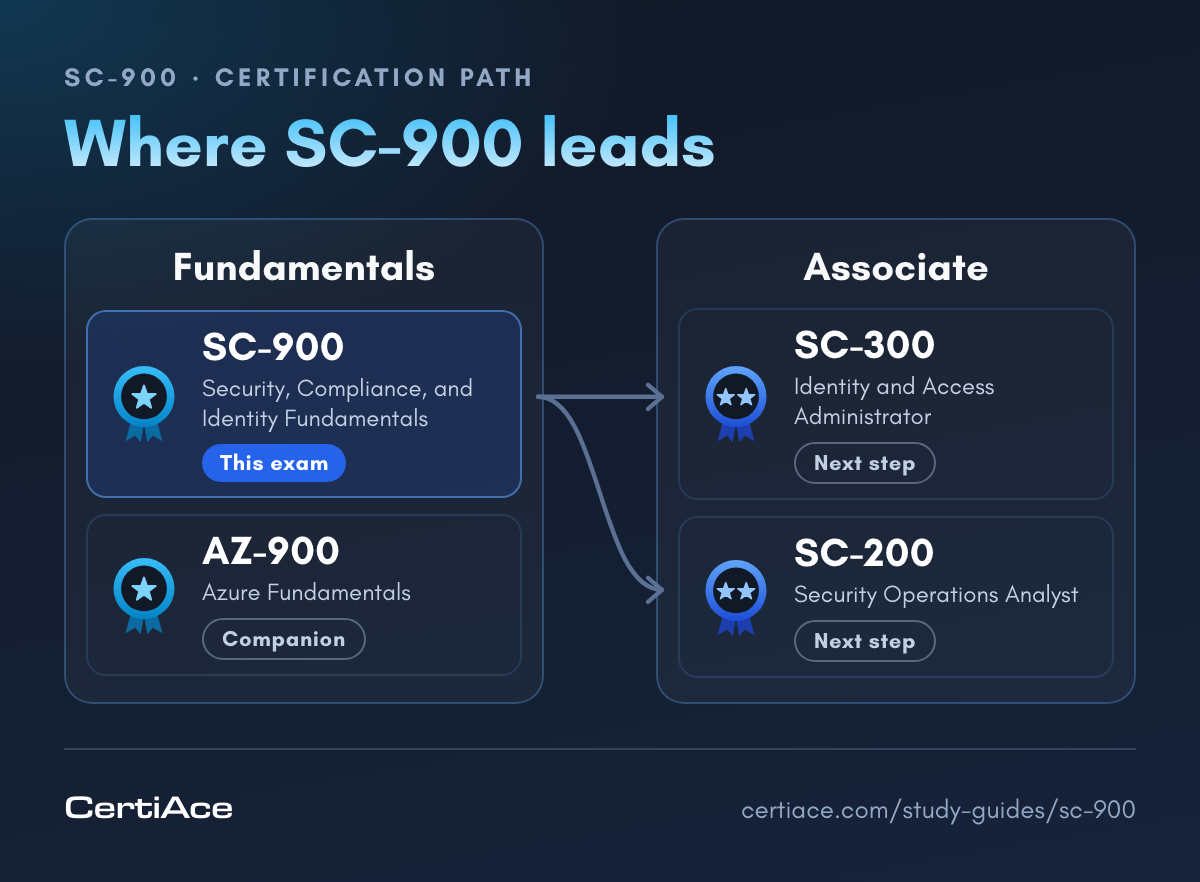
| Certification | What it validates | When to take it |
|---|---|---|
| AZ-900: Azure Fundamentals | General cloud and Azure concepts | Optional companion. Take it before or after SC-900 if you are new to cloud |
| SC-900: Security, Compliance, and Identity Fundamentals (this exam) | Foundational knowledge of Microsoft security, compliance, and identity solutions | You are here |
| SC-300: Identity and Access Administrator Associate | Implementing Microsoft Entra identity solutions hands-on | A natural next step if identity is your direction |
| SC-200: Security Operations Analyst Associate | Threat detection and response with Sentinel and Defender XDR | The next step toward security operations |
SC-900 has no prerequisites. It is designed for business stakeholders, students, and IT professionals alike. You should have a general idea of what Microsoft Azure and Microsoft 365 are, but you do not need hands-on security experience.
Before You Start
The official course lists only light prerequisites. Anything unfamiliar in this table is where to start:
| Area | You should be comfortable with |
|---|---|
| Cloud basics | What the cloud is, general networking and cloud computing concepts (what AZ-900 teaches) |
| Microsoft Azure awareness | What Azure is and roughly what kinds of services it offers |
| Microsoft 365 awareness | What Microsoft 365 is (email, Teams, SharePoint). Several compliance topics live there |
| General IT vocabulary | Users, groups, permissions, servers, and what an IT admin does day to day |
Commonly Confused Pairs
These pairs tend to show up together as the two plausible answers to one question:
| Looks similar | The difference that decides the answer |
|---|---|
| Authentication or authorization | Authentication proves who you are, for example with a password and a second factor. Authorization decides what that authenticated identity is allowed to do, and it always comes after authentication. |
| Encryption or hashing | Encryption is reversible: data can be decrypted with the right key, which protects confidentiality at rest and in transit. Hashing is one-way and uses no key, so the original can't be recovered, which is why systems store password hashes instead of passwords. |
| Microsoft Entra roles or Azure roles | Microsoft Entra roles manage directory resources such as users, groups, passwords, licenses and domains. Azure roles (Azure RBAC) manage access to Azure resources such as virtual machines and storage. By default a Global Administrator has no access to Azure resources. |
| Microsoft Defender for Cloud or Microsoft Defender XDR | Defender for Cloud protects cloud and hybrid infrastructure: it checks the security posture of resources, summarized as a secure score, and defends workloads such as virtual machines, containers, storage and databases. Defender XDR coordinates detection and response across endpoints, identities, email and applications. |
| Compliance Manager or Service Trust Portal | The Service Trust Portal is where Microsoft publishes its own audit reports and whitepapers about how its cloud services protect data. Compliance Manager assesses your organization against regulations and standards, recommends improvement actions and tracks progress as a compliance score. |
| Sensitivity label or retention label | A sensitivity label classifies and protects content, for example with encryption or a watermark, and stays with the file wherever it is stored. A retention label decides whether content is kept, deleted, or kept and then deleted. One document can carry one of each. |
Step-by-Step Study Plan
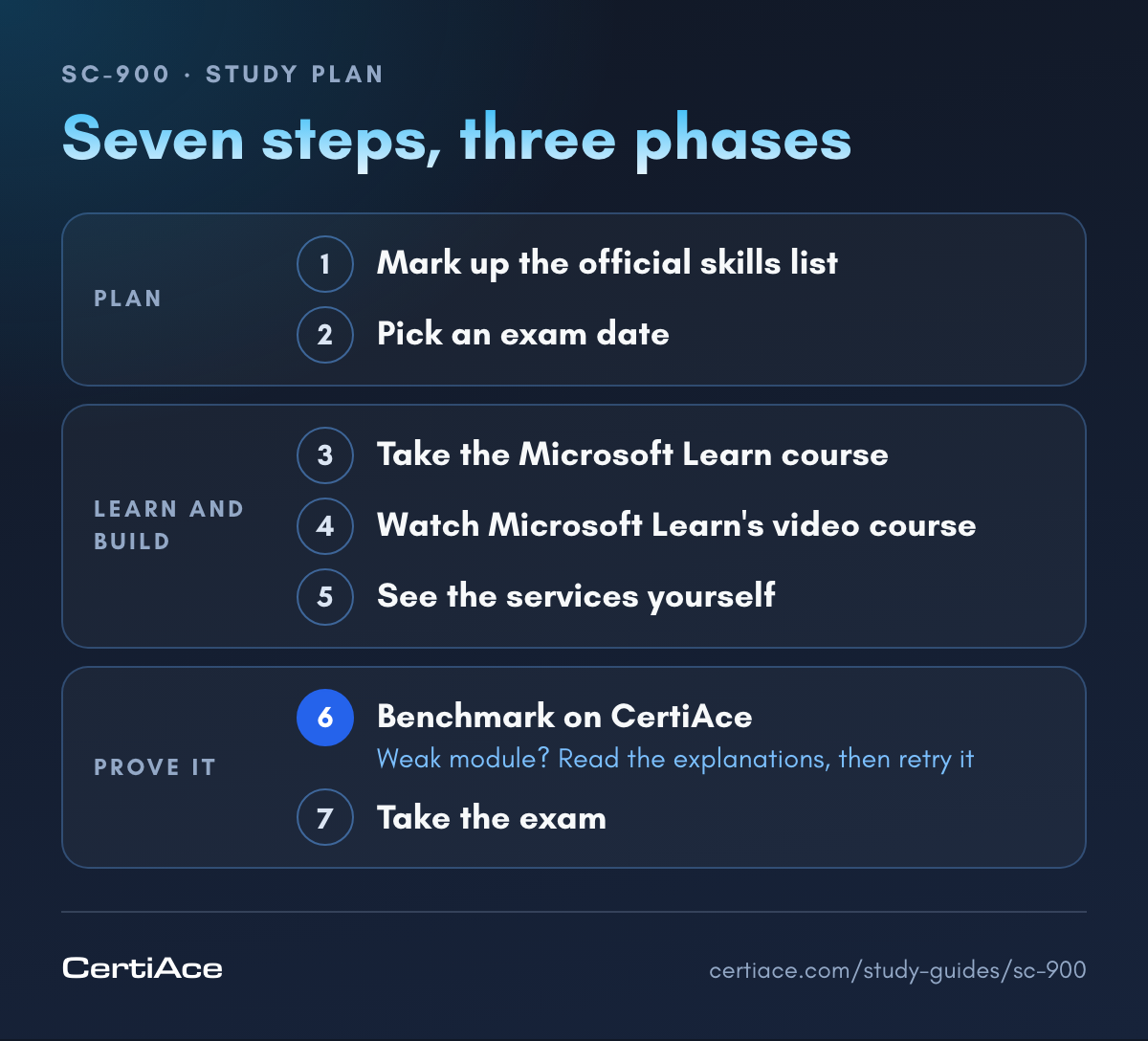
Treat these estimates as planning guidance and adjust them to your starting knowledge and weekly study hours:
| Your starting point | Suggested prep time |
|---|---|
| You work in IT or already know Azure basics | 1 to 2 weeks |
| New to Microsoft cloud and security topics | 2 to 4 weeks |
Step 1: Read the Official Study Guide
Read the skills list once and mark every bullet you could not explain to a colleague. Note that GRC concepts joined the list on July 28, 2026, and older materials miss them entirely. The October 21, 2026 refresh replaced agent ID with workload identities in the identity-types bullet.
Step 2: Schedule Your Exam
Choose a realistic target date after reviewing the skills list and your available study time, then work backwards from it with the prep-time table above.
Certification and Exam Details Page
Step 3: Work Through the Official Learning Path
Complete the SC-900 course modules on Microsoft Learn. They map one-to-one to the exam domains, and the recently rewritten units are unusually close to how the exam words things. Take notes on every concept you cannot explain in one sentence.
Official Learning Path Course Page
Step 4: Watch a Full Video Course
Microsoft Learn's SC-900 course series follows the official course in short episodes, from security, compliance and identity concepts through Microsoft Entra and the Microsoft security solutions to Microsoft Purview. Watch it as a second pass after the learning path, and later rewatch the episodes on your weakest areas.
SC-900 Video Series (Microsoft Learn on YouTube)
Step 5: See the Services for Yourself
SC-900 is a concepts exam, but the concepts stick much faster when you have seen the real thing. With a free Azure account you can open the Microsoft Entra admin center and look at users, groups, and Conditional Access. Explore the Service Trust Portal to see how Microsoft publishes audit and compliance information. Some reports require an organizational account and acceptance of the compliance-materials terms. Focus on recognizing what each service is for: configuration is not tested.
Step 6: Benchmark Your Knowledge
Use CertiAce to benchmark your readiness module by module. The practice modules map to the exam domains as shown above, so use the module mapping and the topics behind your missed questions to identify the skills-measured areas to revisit. Microsoft also offers a free official practice assessment. It is a useful extra check, but it tends to be somewhat easier than the real exam. CertiAce questions are written to sit closer to the real exam's difficulty. If a module stays weak, read the explanations on the questions you missed, then retry that module.
Free Official Practice Assessment
Step 7: Take the Exam
The day before, review only your weak topics. In the exam, eliminate the options from the wrong product family first.
- This is a closed-book exam: unlike the role-based exams, Microsoft Learn is NOT available during fundamentals exams.
- You can take unscheduled breaks, but the clock keeps running and you cannot return to questions you already saw.
- Watch the naming: the exam uses current product names such as Microsoft Entra ID (not Azure AD), Microsoft Defender XDR, Microsoft Purview, Microsoft Defender for Cloud, so cross-check older product names and objectives against the current study guide.
- Try the exam sandbox beforehand so the question formats and interface hold no surprises: Exam Sandbox
Additional Learning Resources
| Resource | Type | Why it is useful |
|---|---|---|
| Exam Readiness Zone | Video series | Microsoft Certified Trainer prep videos. Search for the SC-900 episodes covering each domain |
| Microsoft security documentation | Docs hub | The entry point to every security product doc the exam draws from |
| Microsoft Purview documentation | Docs hub | The compliance domain's source of truth. Skim the overview pages for each solution |
| Microsoft Sentinel documentation | Docs hub | SIEM and SOAR concepts straight from the product docs |
| Security, compliance, and identity community hub | Community | Microsoft's official SCI community: announcements and discussions |
| John Savill's SC-900 Study Cram V2 | YouTube video | One whiteboard session over the whole syllabus, a good final refresher. Use the V2: the original predates the current content |
Realistic SC-900 exam-style questions with instant feedback and detailed explanations.
Practice SC-900 now